Friday, 23 October 2015

Thoughtwebs to wordstrings


Pinker on language is a treat: he gets the point, and to the point, conveys it quickly.

Language is an app for converting a web of thoughts into a string of words.

Speaking is easy, writing is hard. Classic writing was based on language being a window into a world. Last night I dreamt I went to Manderley again. It seemed to me I stood by the iron gate leading to the drive, and for a while I could not enter, for the way was barred to me. There was a padlock and a chain upon the gate.

Sequence matters: the reader needs to know what happened next, and who did what to whom. Active voice is fine, passive voice just as fine when you need to maintain the reader’s focus on a chain of events.

Word strings contain ambiguities, so they need to be worked on until the meaning is clear. Writing involves solving problems of dependent implications: words and phrases in the wrong places create eddies of confusion. (Write in the morning, edit in the evening). Text is a matrix, clarity a work of art.

(Here is a clumsier second version, put in at the editing stage and then taken out again:  Text is a matrix to be arranged with care, pruning out unintended consequences: clarity a work of art.)

The curse of knowledge is imagining that because you know something, everyone else does, and explanations are not necessary. Overcoming that curse requires getting a few target readers to go through your draft to let you know what they don’t understand.

Then: (my paraphrase)Write to make sense.

1) Get your ideas down on the page

2) Arrange the words so the ideas rise off the page for the reader.

The better the writer, the more he will be believed. Many critics of intelligence testing write very well, and carry their readers with them, as good writing usually does. Intelligence researchers must write better. Don’t apologize: explain. Don’t hedge: bet.

These are brief reflections after watching Steven Pinker’s invited presidential address at the ISIR conference in Albuquerque.

http://www.isironline.org/isir-2015-presidents-invited-address-steven-pinker/

I hope I will find it easier to write well.

Thursday, 22 October 2015

Here’s to your health, all 13 parts of it


In general how would you rate your overall health?

Excellent/Good/Fair/Poor/Do not know/Prefer not to answer ?

Self rated health is not a measure I would rate very highly, since it would seem to enfold both the ill and the hypochondriacal in a wetly amorous embrace, leading to nosological confusion. Surely it must be better to take your pulse, blood pressure, and do a full diagnostic workup rather than give any credence to fallible self-observation?

On the contrary, this very general question has extraordinary power. Better Self Rated Health showed positive genetic correlations with intelligence (rg = 0.40), education (rg = 0.59), longevity (rg = 0.33), anorexia nervosa (rg = 0.11), and forced expiratory volume in one second (FEV1) (rg = 0.29). Negative genetic correlations were found between better SRH and neuroticism (rg = -0.38), BMI (rg = -0.41), ADHD (rg = -0.38), major depressive disorder (rg = -0.46), schizophrenia (rg = -0.17), systolic and diastolic blood pressure (rg -0.14 and -0.16), coronary artery disease (rg = -0.33), ischaemic stroke (rg = -0.21), and type 2 diabetes (rg= - 0.38). No associations were found for Alzheimer’s disease, bipolar disorder or the ischaemic stroke subtypes.

How do we know this?

Molecular genetic contributions to self-rated health. bioRxiv preprint first posted online October 20, 2015; doi: http://dx.doi.org/10.1101/029504;

Sarah E Harris, Saskia P Hagenaars, Gail Davies, W David Hill, David CM Liewald, Stuart J Ritchie, Riccardo E Marioni, METASTROKE consortium, International Consortium for Blood Pressure, CHARGE consortium Aging and Longevity Group, CHARGE consortium Cognitive Group, Cathie LM Sudlow, Joanna M Wardlaw, Andrew M McIntosh, Catharine R Gale, Ian J Deary.

http://biorxiv.org/content/biorxiv/early/2015/10/20/029504.full.pdf

The Edinburgh gang and their far-flung confederates have crunched the data from UK Biobank in which roughly 500 000 individuals aged between 37 and 73 years were recruited in the United Kingdom between 2006 and 2010. They underwent testing of cognitive abilities, physical and mental health examinations, completed questionnaires about lifestyle, socio-demographic background and family medical history, and agreed to have their health followed longitudinally. For the present study, genome-wide genotyping data were available for 112 151 individuals (58 914 females, 53 237 males) aged 40 to 73 years (mean = 56.91 years, SD = 7.93).

Neuroticism was measured with  12 questions of the Eysenck Personality Questionnaire-Revised Short Form (EPQ-R Short Form). Intelligence was measured by a thirteen item-test with a time limit of two minutes, completed by 36 035 individuals. Six items were verbal and seven numerical. An example of a verbal question is ‘Bud is to flower as child is to?’ Possible answers: 

‘Grow/Develop/Improve/Adult/Old/Do not know/Prefer not to answer

An example of a numerical question is ‘If sixty is more than half of seventy-five, multiply twenty-three by three. If not subtract 15 from eighty-five. Is the answer:

Possible answers: ‘68/69/70/71/72/Do not know/Prefer not to answer

The Intelligence score was the total score out of thirteen. The Cronbach α coefficient for the thirteen items was 0.62 which is reasonable, given that the whole thing takes no more than 120 seconds. And yes, it uses paper and pencil.

Then they crunch all the slushy stuff that is the very code of life, in various ways, but I will stick to the summary of the genome wide analysis. The GWAS identified 13 independent signals associated with SRH, including several in regions previously associated with diseases or disease-related traits. The proportion of variance in SRH that was explained by all common genetic variants was 13%. Polygenic scores for the following traits and disorders were associated with SRH: cognitive ability, education, neuroticism, BMI, longevity, ADHD, major depressive disorder, schizophrenia, lung function, blood pressure, coronary artery disease, large vessel disease stroke, and type 2 diabetes.  In summary: Genetic variants associated with common diseases and psychological traits are associated with self-rated health. The SNP-based heritability of self-rated health is 0.13 (SE 0.006). There is pleiotropy between self-rated health and psychiatric and physical diseases and psychological traits.

image

Here is the cracker finding: This study shows that the SRH measure, consisting of only one question, is able to reflect the genetic variants of traits and disorders, such as intelligence, personality, cardio-metabolic disease and psychiatric disorders, associated with actual health. Genetic variants associated with higher levels of intelligence and lower levels of cardio metabolic diseases are associated with better health ratings. This supports the theoretical construct of bodily system integrity, a latent trait indicating individual differences in encountering health and cognitive challenges from the environment. Individuals with better system integrity are likely to have higher levels of intelligence, fewer diseases, a better overall health and greater longevity.

The paper is worth reading in detail to get the full argument, and discussions on particular matters like the positive link with anorexia nervosa. System integrity, which Deary named as an afterthought, turns out to be a very powerful concept, increasingly well supported by genetic research. A strength of this study is the large sample size of UK Biobank, permitting powerful and robust tests of pleiotropy between SRH and many health related traits. Other strengths include that all individuals were of white British ancestry, minimising population stratification.

[Note to new readers: Current de facto practice is to avoid genetic group comparisons, despite it being a potential source of understanding genetic effects. However, since genetic groups differ, putting them all into a study can confuse the result. This is one case where apartheid is encouraged, and whites are studied separately.]

The authors end by saying: Measuring people’s overall health is difficult, because the state of the body and mind can be disrupted in many ways, and people’s perceptions of the same objective bodily state can differ. Notwithstanding this complexity, the responses to a single subjective question about whether a person is in good or poor health has proved valid and useful in health research. The present study has been able to identify many genetic contributions to SRH, confirming the complexity of the contributions to the phenotype, and also its partial foundations in genetic differences. The single subjective item of SRH picks up the contributions from many background systems, including mental and physical health, as well as cognitive abilities and personality.

One little question, one very big result.

Wednesday, 21 October 2015

Robert Plomin: “We are truth seekers”

http://www.bbc.co.uk/programmes/b06j1qts


image


The above link takes you to the series of The Life Scientific, in which Jim Al-Khalili interviews scientists, this time Robert Plomin. The program approach centres on the research work of the interviewees, with some examination of the personal factors which led to their main scientific interests. Al-Khalili has a easy style, with the scientists getting a good chance to explain themselves.

To me the great charm of this interview is hearing how a boy from a poor Chicago family was identified and nurtured by teachers at a school which used intelligence tests to identify student’s abilities, and how his family maintained their love and support of someone who otherwise might have found himself estranged by his different interests and his very different abilities. After all the horror stories about intelligence testing, this personal story shows the features which made testing so popular years ago, particularly on the political Left, because it identified bright working class children, whose parents could not afford private schools and personal tutors. Later, when intelligence tests were used as the gateway to heavily rationed, high quality secondary education in Britain they became the whipping boy for every rejected child, and in the end the best, most fair and most accurate indicator (though of course, not a perfect one) was dropped in favour of less good, less fair and less accurate methods, which were vague enough to draw far less political heat. IQ tests carried the rap for the profound resentment created by demand for a limited educational resource. Plomin says (9 min 44 secs) that IQ tests got him to university, but that since then: “Intelligence tests have since been forbidden in America (in schools), a real case of blaming the messenger”.

Al-Khalili gets into a couple of familiar grooves, as many interviewers on the topic do, and as their editors probably feel they must. The first is having a go at “the infamous Bell Curve” (10:17), without distinguishing between the data reporting of part 1 and the policy suggestions of part 2. Plomin explains why the second part does not invalidate the first, because “policy depends on values, not just knowledge” and people can attach different values to a set of observed facts (I am summarising here).

Plomin also says, regarding race differences in intelligence (10:39) “I have ducked them all my life, because it doesn’t explain much variance”. I am not a behavioural geneticist, but I would assume that looking at the genetics of two groups who differ in intelligence, even by only 15 IQ points on average, might give you an inkling whether there were any differences in the two genetic profiles which possibly related to intelligence. In the normal run of science, a difference is interesting because it may lead you to a cause. I think that the more usual reason for ducking researching race differences in intelligence is that it brings you and your team too much hassle, and research effort is wasted, and you will gain more understanding in related fields of genetic enquiry. Academia can be poisonous, so why put good scientists at risk of martyrdom when they can build better understanding of closely related matters?

Then Al-Khalili:  “My concern is that the very fact of describing children as having genetic weaknesses would have a detrimental effect on how they are seen and in time on how they see themselves”. “There are ethical issues about how that data could be used”.  “You can understand why people have avoided this subject for so long”.

Plomin puts up a very good defence. He point out that genetic research confirms: “It is a lot harder for some children to learn than others”. Pushed further, he comes up with a great remark: “We are truth seekers”

Plomin is an experienced interviewee, and does not need my help, but next time a journalist puts you through the usual trope that “your results raise ethical issues and may be twisted” (implying you should stop investigating) , just reply “suppression of enquiry raises even bigger ethical issues, and ignorance is a greater threat than knowledge”.

All things considered, “We are truth seekers” is the best answer.

Tuesday, 20 October 2015

Have criminologists tampered with the crime scene?


I never wanted to be a prison psychologist. As a colleague remarked: “Who would want to have that sort of relationship with one’s clients?” Later on a particular colleague got me interested in the detection of criminals: psychological detective work in which perpetrators were tracked down by the behavioural shadows they left. I found forensic psychology much more interesting, but mostly because it is a difficult problem to solve, and requires well thought out protocols.

Criminology is a different matter. I have always listened politely when having crime explained to me: bad parenting, lack of self esteem, poverty, alcohol, drugs, bad marks at school, lack of early discipline, too much discipline, and sundry other hypotheses in search of an explanation.

http://drjamesthompson.blogspot.co.uk/2014/08/depraved-on-account-of-being-deprived.html

http://drjamesthompson.blogspot.co.uk/2015/06/dull-minds-and-criminal-acts.html

Imagine my relief when Brian Boutwell and colleagues offer me a Unified Crime Theory with an evolutionary perspective. Is this what I have always waited for, or is it just a lump of evolutionary just-so stories?

Brian B. Boutwell, J.C. Barnes, Kevin M. Beaver, Raelynn Deaton Haynes, Joseph L. Nedelec, Chris L. Gibson.  A unified crime theory: The evolutionary taxonomy.  Aggression and Violent Behavior (2015) In Press. http://dx.doi.org/10.1016/j.avb.2015.09.003

https://drive.google.com/file/d/0B3c4TxciNeJZSTJDc3p1aV83VzA/view?usp=sharing

The team outline a number of general issues which a theory of criminality must cover.

First, there are consistent race differences in aggressive, violent, impulsive and  criminal behaviors:

Second, there are consistent sex differences across many measures of criminal behavior: men cross-culturally display greater violence than women

Third, criminal behavior is age-graded: escalates around the time of puberty and then decelerates in the early to mid-20s

Fourth, a small proportion of the population develops temperament and conduct problems very early in development, perhaps even during the first year of life

Fifth, there are genetic influences across virtually every human outcome, including antisocial and criminal behavior, and account for about half of the variance in antisocial behavioral outcomes

Sixth, consistent variation exists across geographic areas (neighborhoods, census tracts, etc.) for measures of crime yet there has not been a consistently supported explanation for why certain areas report more disadvantage, disruption, and illegal behavior.

The authors explain the lack of a unifying theory thus: The lack of unity can be traced to the fact that for decades certain lines of research were censored from the study of crime. Evolutionary biology for example,has struggled to gain true traction in the discussion of the origins of criminal behavior. Mainstream theories of crime causation (which originate within the field of criminology by criminologists) are generally silent on the idea that selection pressures across millions of years of evolution could have shaped the qualities of modern offending behavior.

In my phrase: criminologists have tampered with the crime scene.

The authors suggest using r-K theory to unify the understanding of crime: from the vantage point of evolution by natural selection,criminality is the product of individual variation on certain traits relevant to life history strategies. Natural variation is the key point in that it has resulted in some individuals falling further away from K than others. [] Individuals falling relatively further from K will exhibit faster maturation and lower levels of parental investment. Additionally, they will display greater mating output (i.e., more effort invested in mating, instead of raising children), higher rates of disease and shorter life spans.

The authors quote compelling work on early childhood detection: Around 5–10%of the population begins displaying antisocial behaviors very early in childhood (Moffitt, 1993;Moffitt&Caspi,2001).These behaviors escalate with age eventually manifesting as childhood behavioral problems, transitioning next to adolescent delinquency,and ultimately to crime in adulthood. This segment of the population was termed life-course-persistent (LCP) offenders. According to Moffitt (1993), the proximal predictor of LCP offending was the experience of neurological/cognitive deficits coupled with family adversities including physical abuse and neglect in the first few years of development(although other environmental insults, such as prenatal experiences, could also play a role).

Career criminals (the usual name for life-course-persistent) are more likely to possess traits representing a faster life history(i.e.,deviatingfurtherfromK)in that they disproportionately originate from disrupted homes, evince deficits in impulse control, express difficulty with emotional and behavioral regulation, demonstrate faster physical maturation, reach sexual maturity and engage in sexual behavior at an earlier age,and father a disproportionately large number of offspring (fewer of which survive and thrive). With time and age these individuals should be less likely to engage in long standing pair bonded relationships involving high levels of parental investment.

image

The figure shows that life-course-persistent people are frequently in trouble with the law (exceed the threshold of lawful behaviour) the average citizen sometimes, and abstainers never.

The authors work through their initial points, and show how a life-history perspective applies to each, using the same principles. Just as an example, regarding race differences in crime, Beaver, DeLisi, et al. (2013) reported evidence that once intelligence and lifetime histories of violent behavior were held constant, race differences in criminal justice processing outcomes were no longer observed.

Here is their summary on group differences: There will be group differences in the rate of LCP offending, such that Blacks will be more likely to show signs of LCP offending than Whites, Whites will be more likely to show signs of LCP offending than Asians, and males will be more likely to show signs of LCP offending than females. Conversely, Asians and females will be more likely to exhibit behaviors consistent with Moffitt's (1993) abstainer group. Once again, it is important to reiterate that these group differences will be subtle and that they only apply to the group.This means that offending rates are not expected to drastically differ between groups and that the offending behaviors of any individual may be inconsistent with the group's behavior.

There is a lot in this paper, and since it is expositional rather than data-reporting, it is worth reading the text to go through the supportive data referenced under each of the six points above.

The authors are aware that their paper might seem to be a just-so story, and suggest some initial broad testable predictions:

LCPs should be more likely to be born prematurely, to be born of lower birth weight,and to be exposed to noxious agents prenatally (indeed, Moffitt [1993] suggested many of these possibilities herself). Additionally, LCP offenders are expected to reach sexual maturity more rapidly than their same-aged peers. LCPs will be expected to have more (unprotected) sex with a larger number of partners, yet fewer of their offspring are expected to be reproductively viable and survive until adulthood. The pregnancies of LCP offenders should be more likely to end in spontaneous (and perhaps intentional) abortions, miscarriages, or to experience medical difficulties and complications. LCPs, finally, should be far less likely to invest heavily in their children who survive to birth.

I like the general drift of this paper. I see it as strongest when it shows that, corrected for intelligence and life stage, many of the big differences in the 6 points are reduced, all falling under a common explanatory framework. I agree that mainstream criminology has averted its attention from any explanation of which it does not approve. Of course, my disapproval of improper forensics at the crime scene should not mean unthinking approval of this over-arching theory. I would like further hypotheses to be proposed and tested. As the authors say:

It is our hope that scholars will approach the question of criminality as a scientific query in need of an answer. This type of cold empiricism is far more likely to unearth truth and avoid the trappings of ideological debates. The litmus test for our theory will be whether or not it receives empirical support and our theoretical enterprise will rise, or fall, based on the evidence that accrues either for or against our predictions.

I look forward to the testing of the hypotheses, which I believe will energize criminology in general, and cut through the gluttonous mass of ad hoc explanations for criminal behaviour.

Sunday, 18 October 2015

The Trickster and her patsy


image

Sometimes a few of my readers wistfully ask me to comment on broader subjects, as I used to do at the very start of the blog, almost three years ago. Concerts, restaurants, theatre reviews, travel pieces and such general stuff as strikes my interest, not just the relentless, fearless examination of the intellect.

It may have been in that spirit that on Wednesday I watched Parliament TV. I imagine that this is the habitual entertainment of intense persons who wear hiking shoes and sensible anoraks, earnest prophets newly intending to write down the unwritten constitution of this sceptre’d isle, just as soon as they have exposed, with their sharp pencils, the iniquities of governments and the knavish tricks of the Great and Good who have been caught out leading the long-suffering populace into the risk of infection and the perils of war.

Members of Parliament, long aware of the futility of their calling, looked enviously across the Atlantic to their former colonies, and found that US legislators gave themselves something to do by conducting hearings, and severely cross-examining some of the hapless citizens who pay their wages. MPs decided this would play very well on TV in Britain and have now made a habit of grilling assorted miscreants for the edification and entertainment of the public. Being British, it is a somewhat tame affair, rather like being nuzzled by a dead sheep. (The late Dennis Healey’s RIP withering description of debating with the late Geoffrey Howe RIP).

The Public Administration and Public Affairs Committee is the natural habitat of political groupies. The very name suggests it is a cover for something else, but no such luck. The Committee had before them the chief officer and the chief trustee of a charity which had taken at least £37 million of public money since 2005 to deal with “vulnerable” children. The first session lasted 3 hours. I do not wish to abuse your patience, but if you glance at the first 20 seconds of the link below you may get an understanding of what happened. Possibly even the picture above gives you the general drift.

http://parliamentlive.tv/Event/Index/5e1ce27a-7279-4ba3-9f3f-ed9998fbae7e

A number of issues come to mind. The first issue is why the Government is giving money to charities. In my understanding of the word, charity means charitable persons giving money to charities for them to carry out charitable activities. If people choose not to do that, that particular charity cannot fulfil its objects, and becomes an ex-charity. Why should Government give tax-payers’ money to a charity, particularly when it duplicates work done by government social services? This government policy is based on the belief that charities can either do the work better, or are doing work that governments cannot do. This is possible, of course, but it leads to a distorted relationship: the government has not hired the charity workers, has not vetted them, does not manage them, and cannot sack them; neither can the government prevent the charity from relying on the flow of government funds to expand beyond its contributor base, which then entraps government into using the charity as an arms-length agency, giving it more and more funds on the “too much invested to quit” basis. Such government-dependent charities then use government funds to appoint advisors for the express purpose of helping it generate more government funds, as well as using the government stamp of approval to bring in more private funds, until the misshapen beast becomes bloated and risks insolvency. In this case the government actually seconded two civil servants for a year to try to save their sinking ship.

The second issue is why politicians are prone to being conned. One needs no special explanation as to why so many celebrities are witless (a pop group is said to have donated £8 million, and other public figures clustered round in credulous admiration), but one expects elected politicians to have some sense of stewardship, as well as a crude understanding of the tricks their opponents play on them. This gaggle or midden of politicos are supposed to be street-wise, able to spot chancers, hucksters, liars and thieves a mile off. Why did they fall for this one, particularly when their civil servants did not, and warned them against further largesse? Did they feel solidarity with other confidence-tricksters, or was there a deeper cause?

Confidence-tricksters are often described as “larger than life”. Flamboyance, eccentricity and public recognition assist them in building up their personal brand, and then the end result is that they are considered “charismatic”.  The confidence-trickster has to be confident in themselves, to radiate confidence at public events and touch heartstrings with vivid stories, in pursuit of an apparently noble cause. (On the day the charity folded the charity leader claimed she had just prevented one of her clients from jumping in front of an underground train). The creation of a colourful persona is part of the con, because the individual’s personal battle with authority takes centre stage, and the administrative and financial details get lost. Robert Maxwell, judged in 1971 “not a person who can be relied on to exercise proper stewardship of a publicly quoted company” bounced back to carry out a even greater fraud on his workers, raiding their pension funds. Being an outsider (different class or nationality) is a barrier initially,  but may help later when used as an explanation for other difficulties encountered. The embattled crusader has a place in British history, and most British people quail at the thought that they have written off a beggar for some ignoble reason, particularly a personal hesitancy about their character, which may be due to prejudice.

A brief history of con-tricks is instructive. In the main they play on greed and vanity. The vanity of being seen to be a good person may be motive enough for some people. Usually tricksters offer things at very low prices, and in their more elaborate forms provide what appears to be independent reassurance. A crowd of other investors is the most convincing reassurance.  The manipulators know that some barriers have to be overcome, so they see the “mark” as being not a total fool. Newton famously lamented he could predict the orbits of heavenly objects but not the future of the South Sea company.

The patsy, or credulous convert, is essential. He or she fulfils the function of having been convinced. Once convinced (particularly when it happens against inner doubts) they go out an proselytize with even greater vigour, bringing new contributors into the charismatic presence. They can also carry the rap when the auditors call. According to this trustee’s testimony, he made very substantial personal contributions to the charity, and encouraged friends to do the same. As far as I could tell from his statements, he did not feel he had done much wrong, apart from perhaps needing to have resigned some years before, rather than having hanged on for 16 years.

The third issue is why some charities get the money and others don’t. I recall a confidence trickster woman who raised money for cancer charities by pretending to be a Duchess, thus communicating to her victims that she was above needing the money herself. Those were the days in which a rented Rolls Royce could still impress the punters. Apart from cancer, the successful cause should be both frightening and somewhat unpleasant: something best avoided. Contributions then become an indulgence, promising salvation. This charity concentrated on children which is a plus (the Spastics Society were advised to do two things to get the money: drop pictures of adults, only showing children; and drop “spastics” as a name, so since 1994 they are called “Scope”). 

Kids Company was a compassion play. The children were “disturbed” and “vulnerable”.  The founder lady had the strong belief that “environmental factors would, ultimately, influence how children developed into adulthood through a type of re-wiring of the brain” and some UCL research seemed to confirm this view. UCL Dept of Neuroscience has done interviews with some of them, finding they report high levels of witnessed violence, and MRI results are expected soon. One paper already out (n=22) suggests detectable differences between abused and control children. Obviously, if these brain patterns could be reversed…. Financial controls were haphazard at best. Cash was delivered to clients, sometimes well into adulthood. The charity leader had effective control of expenditures, and hired more staff than warranted as her empire expanded. (Many charities prioritise staff appointments over fulfilling their objectives, and become poorly-regulated quasi-businesses).

Who were the clients? Of course, specific clients would not be identified if they were receiving public services, but charities enter a grey area: in government benefits departments there are some rules to be kept which can be monitored, but a charity has more leeway, because it is dealing with its own flexible concepts of “need”. The numbers being seen were claimed to be 36,000 by 2011, but apparently this included all the other children in schools where specific children were taking part in Kids Company therapy sessions or activities, which is not the usual way of measuring clinical load. Some, or many, were given cash payments without their subsequent purchases being supervised in any way. The charity had many backers. In the opening sentence of the preface to a laudatory account of the charity Prof Jovchelovitch (London School of Economics) remarked that when she first met Miss Batmanghelidjh she had been “immediately struck by the beauty and profound truth of her simple message”. This is not the usual way of conducting academic evaluations of clinical services. The “colourful” charity leader was fond of meeting Prime Ministers and celebrities, and made sure that these meeting were well publicized.

Is this an example of otherwise intelligent people lacking intelligence, or lacking “social” intelligence? The politicians who clustered round may have done so on the crude calculation that it gave them welcome publicity as warm-hearted and generous people helping wounded little children: virtue signalling. In point of fact they may have been subsidizing delinquents who made their neighbours’ lives a misery, but that was less discussed. Even more cynically, the politicos may have judged that childhood sexual abuse was a toxic issue, and wanted to be seen on the right side of the often rabid debate. Another option is that when politicians detect an unsolvable problem (many children will be badly raised by incapable or unwilling parents, resulting in unhappy and demanding young adults) they lose all critical ability and simply hand over tax-payer’s money.

Deciding whether to contribute money to a charity tests more than the charity of the donor. It requires you to look past wish-fulfilment and the professed good intentions of charity fund-raisers to estimate the realistic probability of those intentions resulting in the desired outcome. Yet another intelligence problem.

Or, if you want a simple rule of thumb, avoid donating to any charity led by someone better known than the charity.

Thursday, 15 October 2015

Are bright men sexy?: Author Lars Penke replies

http://drjamesthompson.blogspot.co.uk/2015/09/do-women-find-bright-men-sexy.html

http://drjamesthompson.blogspot.co.uk/2015/10/male-intelligence-and-what-women-really.html

Having looked at the abstract of the conference presentation, and his further and more detailed particulars,  I sent Lars three comments on 12th October, and uppermost in my mind was whether the experimental set up was a fair match with real interactions.

Are there any methodological reasons to doubt the applicability of the results?

“Make me laugh” seems a very fair test of the “g is sexy” hypothesis, so your experiment seems a strong refutation.

However, the German abitur examination is at quite a high level, so if two thirds of them have achieve that, could there be a restriction of range which would reduce the intelligence effect?

Lars replied:

Of course you can always design a better study in some way, but I think we made a substantial effort to get exactly at the Mating Mind hypothesis. I discussed this study quite intensely with Geoffrey Miller (who is a friend of mine), and he agrees that it is getting at what he originally proposed.

German Abitur rates in the population are close to 50% nowadays. So yes, the sample is not completely representative, but we made a good effort to get other guys than the standard students into the lab. I have no doubt that very low IQ is unattractive, and those guys are missing from our sample. But I think we capture the normal range decently well. It is close to impossible to get a completely representative sample into a psychology video lab for an extensive study, unless you can pay them a lot. None of the men studied psychology,  by the way.

All the female raters were students, most of them psychology students. Psychology admission in Germany is highly dependent on very good grades, so the female raters were most likely above average and above the male sample in IQ. Crucially this means that assortative mating for intelligence did not bias our results, as this would have only strengthened any tendency for high IQ to increase attraction, which we did not find.

Just saw your blog: "Women were unacquainted with men" did not mean they were virgins, but that they did not personally know any of the men they rated! We did not assess their sexual history, but given their demographics it is safe to assume that most if not all of them had sexual and dating experience.

One unexpected problem with this sample is that g correlated negatively with self-reported Extraversion, which it usually doesn't. This is likely a sampling bias: The extraverted non-students were more likely to come to our lab. All we could do after the fact was statistically controlling for Extraversion.

Comment: I think this covers my questions very well. The procedures were accepted as a fair test of the “bright men are attractive” hypothesis, of which “make me laugh” is a crucial component, and the qualification levels of the target men are not all that much higher than the general population.

I think it also covers most of the other comments, but over to you on that score.

Wednesday, 14 October 2015

Connectivity matrix predicts fluid intelligence

The enchanted loom is slowly giving up its secrets, of which it holds many. The patterns of brain activity that so many researchers have tracked with wonder are beginning to reveal a larger pattern: the possibility that each of us has a habitual pattern of brain activity which identifies us, and distinguishes us from others. So, dear reader, we are separated by the idiosyncratic rhythms of our brains, dancing to a different beat, visiting a different pattern of cortical locations, and no doubt coming to different conclusions. How good to at least have a common language in which to discuss these findings. Also in common, to my great surprise, is that the pattern of detected brain activity is predictive of fluid intelligence. To solve problems, it would seem that our brains have to do very similar work. The better they do so, even with their individual variants, the better we solve problems. So, we are individuals, though with individual problem-solving patterns of different power.

The unexpected finding which I find startling is that individuals can be identified by their habitual brain patterns (not just on specific tasks) and those patterns of activity predict fluid intelligence on Raven’s Matrices at about r=0.5 This is about as good as another mental task, though not good enough as a Wechsler subtest (where 0.6 or 0.7 and above is required).

Functional connectome fingerprinting: identifying individuals using patterns of brain connectivity

Emily S Finn, Xilin Shen, Dustin Scheinost, Monica D Rosenberg, Jessica Huang, Marvin M Chun, Xenophon Papademetris & R Todd Constable. Nature Neuroscience(2015) doi:10.1038/nn.4135 Published online 12 October 2015

http://www.nature.com/articles/nn.4135.epdf?referrer_access_token=i1m4OO05GSqQMVlNu3bK59RgN0jAjWel9jnR3ZoTv0PdTRzPbAYp-zLQNUeREd-wdwR0koaPIcJz2NczhgmrD9IJurCxtZ57I5a5H2t7ILI8SR_QGtdSyvFThYSs-QyezJl8JuuFWMIvmk69ecHqX5CdHmkvKcWDBkbTFJYSvqKX0oHQ3YoDNXRlf51fQUeD8gDftjh4QQlvHRow9Qq3kBn4bhepOk8Xe-FGZGaPx9A%3D&tracking_referrer=www.wired.com

The authors say: Functional magnetic resonance imaging (fMRI) studies typically collapse data from many subjects, but brain functional organization varies between individuals. Here we establish that this individual variability is both robust and reliable, using data from the Human Connectome Project to demonstrate that functional connectivity profiles act as a 'fingerprint' that can accurately identify subjects from a large group. Identification was successful across scan sessions and even between task and rest conditions, indicating that an individual's connectivity profile is intrinsic, and can be used to distinguish that individual regardless of how the brain is engaged during imaging. Characteristic connectivity patterns were distributed throughout the brain, but the frontoparietal network emerged as most distinctive. Furthermore, we show that connectivity profiles predict levels of fluid intelligence: the same networks that were most discriminating of individuals were also most predictive of cognitive behavior. Results indicate the potential to draw inferences about single subjects on the basis of functional connectivity fMRI.

They scanned 126 subjects (22 to 35 years of age, and only 40 of them men, but a larger sample than the usual n=16 neurobollocks stuff) 6 times over 2 days and showed that the functional connectivity profile derived from one session could uniquely identify the individual from the set of profiles obtained on the following session. Identification is successful across rest sessions, task sessions and even across rest and task. So, the brains are identifiable regardless of what they are doing in terms of activity. You are special, in your own way (and everyone else also).

Intelligence was assessed with a 24 item version of Raven’s Matrices. This is a good test, though a bit crude at higher levels. Then, in an interesting procedure, they chose one scan as the test item, and used all the rest (n-1) to create a model based on positive and negative discriminative features, and from that model generated a prediction about the Raven’s score. The positive feature model correlated 0.5 with the actual intelligence scores. When different regional networks were compared, the most consistent correlations were with the fronto-parietal networks at 0.42

image


The authors compare the distinctive brain activity patterns to a fingerprint. They can identify individuals with near perfect accuracy from their connectivity matrix. They obtained their most accurate predictions by combining the two fronto-parietal networks, which deal with higher-order associations and are the most recent in evolutionary terms, and also show the greatest inter-subject variability.

Comment: The sample size is good for this sort of work. Identifying individuals could be harder with larger sample sizes, so we will have to see if the fingerprint analogy is merited (though at very high population numbers fingerprints are not always discriminably unique). It would be interesting to see if the addition of other intelligence measures improves the correlation. I think it would give better fine detail in the higher range of ability.

Overall, taking all things into consideration, Wow.

Monday, 12 October 2015

Male intelligence and what women really want


Although not yet published, Lars Penke has kindly let me see his full presentation about whether women find bright men sexy.

http://drjamesthompson.blogspot.co.uk/2015/09/do-women-find-bright-men-sexy.html

Not much, these experiments show. Yes, they are experiments, and these are always at some distance from real life. One day people may record every stage of courtship, but until then some manipulations are required.

https://drive.google.com/file/d/0B3c4TxciNeJZaVlSVzEtNklQbzQ/view?usp=sharing

The researchers have given the guys every chance to reveal their intellects and, crucially, the women making the judgments are able to hazard guesses as to how bright the guys are, which correlate 0.34 with tested intelligence. This is interesting in itself. I never claim to be able to judge intelligence immediately, but these women seem to do so at better than chance level.

The researcher’s conclusions are as follows:

  1. Physical attractiveness is still the strongest predictor of initial attraction, for both long- and short-term mating
  2. Intelligence can be accurately perceived at first sight
  3. g has small positive effect on female long-term attraction
  4. g hardly increases female short-term attraction
  5. Intelligence has likely not been “genetically captured” by sexual selection as a genetic fitness indicator

My conclusion: Women can somewhat predict male intelligence, and would probably do better in a real conversation. Physical attraction is what they want, at least on this controlled presentation, and before they can carry out more extensive enquiries (which may or may not lead to investigations of penile girth, supposedly another important matter).

Finally, the slides say of the women judges that they were “unacquainted with men”. If true, this would be a major methodological flaw. What would virgins know about the attractions of intelligent men?  How is a bright guy expected to impress a woman unless he can follow up his humorous introductions with a highly crafted and intelligent sexual performance?

Perhaps it means “not acquainted with these particular men” but surely the researchers would do the decent thing, and pass on the young men the telephone numbers of those young women who, upon hearing them tell their jokes, found themselves overcome by lust?

Friday, 9 October 2015

Mass killings as 15 minutes of performance art

Some years ago, as part of the very broad range of work which has come my way by virtue of being a psychologist, or being thought to be a psychologist, two Police officers came to my office with a complicated problem.

An armed man had taken two women hostage. I will draw a veil over the details of the case, for fear of anyone being identified. A siege ensued, and a policeman was given the task of building up a negotiating relationship with the hostage taker, by chatting to him on a telephone link. Although the policeman had probably received some training, he was not experienced in these matters (protracted sieges are relatively rare in the UK). After some days of companionable conversation the perpetrator asked his police contact what was the record length of a domestic siege. Without much thought the policeman gave him the then current record, which led to the man holding the women for an extended record number of days, during which they were badly abused by him.

An anthropology professorial colleague later questioned me about it, and was glad to find that his theories were confirmed: criminals are as much in need of recognition and as bound by theatrical traditions as any other performer, particularly the duller ones without any other options and incapable of innovation.

The hostage taker knows that he has to keep things going until the TV vans arrive. Then he has to make protestations of innocence, describe a grievance, request special privileges, have specific people brought in to plead with him (priest, schoolteacher, celebrity, former spouse), require special foods and finally demand that his manifesto be published. Then he can concede and be led away to a police van, shouting his final demands, or repeatedly fire his weapons out the window and then storm out of the building into a hail of bullets, according to preference and accepted conventions.

Mass shootings in the US now have a gristly ritual to them. One is under way at North Arizona University as I write this, and there is no need for news outlets to explain what “lockdown” means.  On later investigation it will probably turn out that long justifications and opaque warnings were made on social media, with coded farewells, then ritual dressing for combat (in a variant of the kamikaze tradition), gathering the arsenal of fearsome weapons, the highly symbolic choice of target, and in the US cultural setting, the hail of bullets finale, leading to posthumous publication of The Statement.

I quail from giving a list of these mass killings but some of the worst are: 21 killed, 19 wounded; 22 killed, 20 wounded; 32 killed, 17 injured. 7 killed 7 injured seems to be a rough median, and they would not have been achieved without guns.  

Can one detect such killers beforehand? The usual answer from psychiatry is “not without locking up much of the population”. I have some sympathy with this view, though it is more of a judgment about psychiatry/psychology than it is about criminality. Murder is rare, and mass murder much rarer. (The likelihood of a subset should not be greater than the likelihood of the set from which the subset has been derived.)   Rarity might help in detection, but usually doesn’t, unless the rare behaviour has a strong link with something, like narcolepsy often has with orexin. Steve Sailer wonders what the credit scores of mass shooters are. This could be fertile ground. Credit card companies claim to be able to predict divorce better than spouses (but it probably takes only a few hotel bills in out of the way places to reveal an affair). Certainly the credit card records of Islamic terrorists are often very illuminating. As a rule of thumb, it is very unusual for extreme behaviour not to have a precursor, though some come out too late to be of much use. A sudden change in appearance (change of hairstyle; change of clothing from casual to devout, or less often the reverse; or from functionally sociable to taciturn) in the weeks and days before an event are usually seen only in retrospect. In UK policing a good way of catching criminals is to have spot checks on cars. Those who haven’t bothered to insure them contain a higher than usual proportion of people who haven’t bothered to return “borrowed” property, to attend court hearings, and to observe other, more major, laws. The sieve of minor transgressions reveals the richer soup of criminal noodles.

An impossibly disorganised credit history might be an indicator of a disorganised life, but the regression equation would probably have to include 5 or 6 predictors. What would they be if one was trying to predict US mass shooters? Guns might be a poor predictor (too widespread); multiple arms purchases perhaps somewhat better; internet viewing and postings a good predictor; social isolation a  fairly good predictor, but by far the largest category seem to be workplace grievances, followed by school/college arguments and marital disputes involving prior threatened or actual violence. Vengeance is served hot.

Each of the indicators might have a hit rate of barely 1 in 50, but carefully combined they might might have some predictive value. What then?

However, one general facilitator of these crimes might be a general un-willingness on the part of neighbours, work mates and fellow students to regard threatening and violent behaviour as reprehensible if it is classified as “mental health issues” and psychologists are involved, and to be too embarrassed to say: that person scares me, and I want them kept at a distance.

Perhaps if some behaviours go beyond the usual norms they need to be stigmatised again.


Tuesday, 6 October 2015

The Tetlock Forecast

I have admired Philip Tetlock since, almost 30 years ago, he reviewed a book I had just written which contained one big and so far untested prediction, and gave it by far the most detailed, insightful and helpful assessment it had received among many warm but perfunctory reviews, mildly adding references to a few papers which, when I followed them up, showed me exactly how much I had missed out. His kindness made his critical points far more effective. (In a subsequent lecture tour I met up with one of the international affairs experts he had mentioned, who offered to work with me, though in the end I went on to other things, and consequently made no revision of the book).

Tetlock, P.E. (1986). Review of J. Thompson, Psychological aspects of nuclear war. British Journal of Social Psychology, 25, 78-79.

Now the Press are picking up his work on super-forecasting, which has major implications for how we go about anticipating and planning for future events, supposedly one of the features of high intelligence. Bright people should be particularly good at forecasting, shouldn’t they?

Superforecasting: The Art and Science of Prediction. Philip Tetlock and Dan Gardner. Sep 29, 2015

What has Tetlock found? First, that most pundit forecasts are unfalsifiable. Even time travel would not help you know if the predictions of these commentators had been met. They are at the low level of Nostradamus and contemporary journalism. Second, if you run a proper forecasting contest (not “will there be a stock market correction sometime soon” but “what will the Standard and Poor index stand at on 31 December 2015”) most commentators are “too busy” to participate. They do the broad brush stuff which gets well paid, not the nitty-gritty testable stuff  that nerds do for fun.

In his 1953 essay on Tolstoy’s view of history, Isaiah Berlin drew a distinction which he intended to be no more than an intellectual game, though he later admitted that every classification throws light on something.

There is a line among the fragments of the Greek poet Archilochus which says: ‘The fox knows many things, but the hedgehog knows one big thing.’  Scholars have differed about the correct interpretation of these dark words, which may mean no more than that the fox, for all his cunning, is defeated by the hedgehog’s one defence. But, taken figuratively, the words can be made to yield a sense in which they mark one of the deepest differences which divide writers and thinkers, and, it may be, human beings in general. For there exists a great chasm between those, on one side, who relate everything to a single central vision, one system, less or more coherent or articulate, in terms of which they understand, think and feel – a single, universal, organising principle in terms of which alone all that they are and say has significance – and, on the other side, those who pursue many ends, often unrelated and even contradictory, connected, if at all, only in some de facto way, for some psychological or physiological cause, related to no moral or aesthetic principle. These last lead lives, perform acts and entertain ideas that are centrifugal rather than centripetal; their thought is scattered or diffused, moving on many levels, seizing upon the essence of a vast variety of experiences and objects for what they are in themselves, without, consciously or unconsciously, seeking to fit them into, or exclude them from, any one unchanging, all-embracing, sometimes self-contradictory and incomplete, at times fanatical, unitary inner vision. The first kind of intellectual and artistic personality belongs to the hedgehogs, the second to the foxes; and without insisting on a rigid classification, we may, without too much fear of contradiction, say that, in this sense, Dante belongs to the first category, Shakespeare to the second; Plato, Lucretius, Pascal, Hegel, Dostoevsky, Nietzsche, Ibsen, Proust are, in varying degrees, hedgehogs; Herodotus, Aristotle, Montaigne, Erasmus, Molière, Goethe, Pushkin, Balzac, Joyce are foxes.

(As you can see, Isaiah Berlin could write. He was also very kind, and a friend tells me stories about him, while pointing at the two prints Berlin gave him).

Tetlock has taken this distinction to heart as a classificatory system.  Forecasters can have a specialist, narrow focus expertise (hedgehogs) or a broad overview, using plagiaristic combinations of other people’s deep knowledge plus their own feelings (foxes).

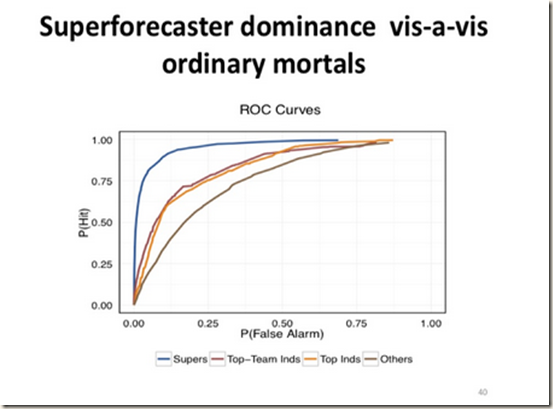
After conducting many prediction contests, Tetlock finds that some people are particularly accurate, and deserve the accolade of being superforecasters. Superforecasters could assign probabilities 400 days out (before the event) about as well as regular people could about eighty days out. Many of the superforecasters were quite public-spirited software engineers. Software engineers are quite over-represented among super-forecasters.
 

image

A surprisingly large percentage of our top performers do not come from social science backgrounds. They come from physical science, biological science, software. Software is quite overrepresented among our top performers. If you looked at the personality profile of super-forecasters and super-crossword puzzle players and various other gaming people, you would find some similarities.    

The individual difference variables are continuous and they apply throughout the forecasting population. The higher you score on Raven’s matrixes the higher you score on active open-mindedness, the more interested you are in becoming granular, and the more you view forecasting as a skill that can be cultivated and is worth cultivating and devoting time to, those things drive performance across the spectrum, and whether you make the super-forecaster cut, which is rather arbitrary or not. There is a spirit of playfulness that is at work here. You don’t get that kind of effort from serious professionals for a $250 Amazon gift card. You get that kind of engagement because they’re intrinsically motivated; they’re curious about how far they can push this. 

Comment: I think this makes sense. These super-forecasters are probably counters, not chatterers, that is, STEM not Verbal, with high fluid intelligence. Software has to work, and there are many, many ways in which it can go wrong. Murphy’s Law applies. Programs have to be tested to flush out errors, and you have to simulate the special situations users will create which can make an untested system crash. This background makes software engineers cautious, humble, and supremely focussed on “on budget, on time”.

Tetlock tried to boost forecasting accuracy by means of his Good Judgment Project, and found that his training techniques could boost accuracy by 50-70% from the group average. The project does this in the following ways:


image

The test of fluid intelligence was Raven’s Matrices. I promise you I began writing this post without knowing that. What I thought would be a little break from intelligence research turns out to prove the adage that intelligence runs through human life like carbon through biology.

You may have heard about the wisdom of crowds. I am with Dryden (1668) when he said: If by the people you understand the multitude, the hoi polloi, tis no matter what they think, they are sometimes in the right, sometimes in the wrong; their judgment is a mere lottery. As a general rule, crowds are in favour of war at the beginning of wars, and against them if they drag on, which most of them do.


image

So, the wisdom of crowds depends on the intelligence of the crowds, or more precisely, it is boosted by paying extra attention to intelligent crowd members. Where opinions are polarised, then one option is to use an algorithm to combat the centralising and emasculating effect of those clashing perspectives. This helps get useful predictions out of crowds, but does not help super-forecasters (who probably know how to combine conflicting opinions anyway).

An example of Kahneman based predictive training is this rule of thumb: The likelihood of a subset should not be greater than the likelihood of the set from which the subset has been derived.   

What we’re trying to encourage in training is not only getting people to monitor their thought processes, but to listen to themselves think about how they think. That sounds dangerously like an infinite regress into nowhere, but the capacity to listen to yourself, talk to yourself, and decide whether you like what you’re hearing is very useful. It’s not something you can sustain neurologically for very long. It’s a fleeting achievement of consciousness, but it’s a valuable one and it’s relevant to super-forecasting.     

The beauty of forecasting tournaments is that they’re pure accuracy games that impose an unusual monastic discipline on how people go about making probability estimates of the possible consequences of policy options. It’s a way of reducing escape clauses for the debaters, as well as reducing motivated reasoning room for the audience.    

Regarding partisan pundits, Tetlock says:

High stakes partisans want to simplify an otherwise intolerably complicated world. They use attribute substitution a lot. They take hard questions and replace them with easy ones and they act as if the answers to the easy ones are answers to the hard ones. That is a very general tendency.

Does my side know the answer? is the really hard question. The easier one is, whom do I trust more to know the answer, my side or their side? I trust my side more to know the answer. Attribute substitution is a profound idea, and it allows us to think we know a lot of things that we don’t know. The net result of attribute substitution among both debaters and audiences is it makes it very hard to learn lessons from history that we weren’t already ideologically predisposed to learn because history hinges on counterfactuals

Tetlock is now focussing on the societal impact of his findings, hoping to improve the predictions on which decisions are based. The minimalist goal is to make it marginally more embarrassing to be incorrigibly close-minded, just marginally. The more ambitious goal is to make it substantially more embarrassing, and that requires talent and resources of the sort that academics like myself don’t possess. I don’t know how to create a TV show.       

Tetlock has some advice for improving forecasts. Like most advice it has some disappointments, in that a researcher close to the material understands in detail what is meant by “strike the right balance” but the phrase itself is of little help, simply an irritating truism.

Ten Commandments for Aspiring Super-Forecasters

1 Triage. Concentrate on questions which lie in the Goldilocks Zone between Clocklike predictable and Cloudlike impossible.

2 Break seemingly intractable problems into tractable sub-problems. How many potential mates will a man find in London? Divide the total population by half to get the number who are women, then by those in his age range, those who are single, those of roughly the right age, those with a university degree, those who he will find attractive, those who will find him attractive, those who will be compatible and you end up with 26 women out of a population of 6 million.

3 Strike the right balance between inside and outside views. How often do things of this sort happen in situations of this sort? When estimating the time taken to complete a project, take the employee estimate with a pinch of salt, and the client estimate as a correction factor.

4 Strike the right balance between over-reacting and under-reacting to evidence. The best forecasters tend to be incremental belief updaters, slightly altering probability estimates. They also know when to jump fast.

5 Look for clashing causal forces in each problem. Understand both thesis and antithesis, summarize both so you recognise how they will develop, then attempt synthesis.

6 Strive to distinguish as many degrees of doubt as the problem permits but no more.

7 Strike the right balance between under- and overconfidence, between prudence and decisiveness.

8 Look for the errors behind your mistakes but beware of rearview mirror hindsight biases.

9 Bring out the best in others and let others bring out the best in you.

10 Master the error-balancing bicycle.

To get further into this, either read the book or look at his Edge masterclass (5 parts) in which he answers question and responds to suggestions.

http://edge.org/edge-master-class-2015-philip-tetlock-a-short-course-in-superforecasting

Comment

This is a first look at an engaging and important problem: how to perceive the world accurately enough to work out what will happen next. Intelligent beings need to be accurate much of the time. If Alex Wissner-Gross (2013) is right, intelligence is a thermodynamic process, and can spontaneously emerge from any organism’s attempt to maximise freedom of action in the future. The key ingredient seems to be the maximisation of future histories.

The key to decision making is to keep one’s options open, the most important option being staying alive.