Sunday, 1 November 2015

The Matrix

It was usual, in times of old, when Knights came courting a Princess, for the King to set suitors a challenge, usually involving them attacking troublesome neighbours or retrieving stolen property. This was an “all or nothing” measure of the suitor’s capabilities. In psychometric circles no proper clinician would be so crude. We know that tests vary in quality, and that test takers vary in ability, so it is more subtle and more indicative to see at precisely what point a string of successes breaks down into occasional errors and then eventual defeat. Humbling, this experience, to see the chatty and confident applicant, who has sailed through so many items, suddenly confronted with precisely the level of difficulty which fractionally exceeds his ability. Times lengthen, expressions change, and the tester must now encourage and reassure lest the applicant falter. Tests, and life, reveal this highly personal matrix, in which persons are plotted against problems, and the series of ticks gives way to a terminal cross.

Far from each item being just like the others, each has their own peculiarities, a mixture of inherent difficulty, and bits of fluff that stick to the pure item, contributing nothing but confusion. Experienced testers quickly spot items which they consider problematical. Most ambiguous items are rejected at an early stage of standardisation, but some marginal ones remain. They are not bad in themselves, but cannot be relied upon so strongly as other, better, items. For example, an item may trigger a misunderstanding which inadvertently causes errors. Also, in a short test the jumps in difficulty level may be too big, so that it would have been better to have more intermediate items. The items are not “wrong” but the overall progression of items is too lumpy (and often results in above average performers getting less fine grain results).

Item response theory delves deeply into these matters, looking at how each person responds to each item, thus teaching us much about the person and the individual task. At heart the concept is simple (though the maths, as usual, can get complicated): a general trait is tested at a number of points, and the probability of getting an item right (the pass rate) is a mathematical function of the person characteristics (in this case, the latent factor of problem-solving ability) and the item characteristics (difficulty level, discriminative power). In this theoretical approach the focus of attention is on the item while in classical test theory the focus is on the test as a whole, the total of all the items.

I like studying individual items in case where there are few of them and much reliance is to be placed on them. Like legal evidence, if much depends on a single witness or a single forensic result, then critical enquiry must be severe. When we have many test items, across a broad range of behaviour, it is still worth studying items just as a check, but they become a matter of indifference. The “indifference of the indicator” in Spearman’s phrase means that the precise content of intelligence tests is unimportant for the purposes of identifying general intelligence, because it enters into the performance of all kinds of tests. If tests (and individual items) do the job of discriminating between persons in a way which has predictive utility then, whatever they are, they are useful.

By the way, far from being an obscure aspect of intelligence testing, IRT applies to all test items, and is mostly used in educational settings to design and evaluate scholastic tests. It helps compare exams in different years, and to build up a bank of test items of known difficulty. It is a far more detailed and subtle approach than just looking at the total test scores, though it requires much more computational work. Any putative new test, of “emotional” intelligence or “rational” intelligence or “multiple” intelligence has to jump through the same hoops. New tests aren’t breakthroughs just because they haven’t been standardised yet.

In crude terms (which is the way I think most of the time) items are most efficient when they have a 50% pass rate. This is the most powerful way to sort out the sheep from the goats. Items with higher pass rates are useful as starter items, encouraging participation in the test. Harder items will have lower pass rates, though these risk discouraging most test takers. So, a test should begin with easy items (pass rates of 100% if possible) then gradually go on to lots of middle ranking items (pass rates of 40-60%) which build up the reliability of the test, and then the final harder items (pass rates of 5-20%) to pick out rarer intellects. Each test taker leaves a pattern of scores. If students who do very well overall have had difficulty with an item in the middle range of difficulty, then that item needs a closer look. Conversely, if a moderately difficult item is a particularly good predictor of later success on harder items, it is a gem worth keeping, and understanding better.

My preference is to have the items plotted out for me so that I can see pass-rates per item. If you work out the item response function you can calculate the probability that a person with a given level of ability will answer correctly.

Here is a slightly more complicated illustration, showing responses to a dichotomous item, usually a multiple choice test item:

image

The X axis shows item difficulty, and the midpoint b=0.0 corresponds to the average obtained by a representative sample of test takers. Each item can be located on that axis of difficulty, which corresponds to the pass rate of a representative sample. The average corresponds to a pass rate of 50% and it is also the point of maximum discrimination.

The Y axis is item discriminability, and the depicted curvy line is the shape of the actual response function. The discrimination of this function is around 0.6. Simply guessing in this case would be 0.25

a=1.0 gives you the slope of the function (its capacity to discriminate between test takers).

Of course, this is an idealised function, and all this depends on assumptions being met, that the test-takers don’t confer and that the items are truly independent.

Raven’s matrixes test has response function curves drawn out for every item, and they are broadly similar, though one difficult item is placed too low in the sequence (where it is found to be hard by people of all cultures and genetic groups).

In summary, every problem we ever face is an item on the Matrix, and we get a score on every item, as do all other test-takers. Items vary in their power to discriminate intellects. The task for us is to go as high up the matrix as we can, and stay there for as long as possible, practising the tasks which are possible at that difficulty level. The task for society is to put the best test-takers onto the hardest problems, so that they obtain solutions we can implement.

Jensen argued that success equals ability times effort times opportunity. If any of those three is zero, then zero is the final result. Open societies offer the best opportunities in the world (which is why so many people want to move to them). Given that, effort must be applied to obtain the best out of ability. Effort, or practice, may account for only one third of the variance among those who make the effort, but without effort the final result is always zero.

Find your place on the matrix, and get busy.

Friday, 30 October 2015

James Thompson Bond

image


The Bond movie “Spectre” is out. I don’t need to be told that Bond movies follow a classic format in which the hero, prior to going to war, visits a priestly magician who gives him a cloak of invisibility, potions to make him strong, a range of wondrous weapons and a cunningly hidden panic button which raises him to safety from the ravening jaws of the Furies. It’s a movie, after all: great fun, great car chases, beautiful women, beautiful photography: five travelogues in search of a plot.

Towards the end, the boss of the good guys, depressed at being dispossessed of his job and cast out of his MI5 headquarters, is seen on his own, nursing a final late dinner glass of wine in a traditional London restaurant. “Rules” I muttered to my esteemed companion, though she did not believe me till the final departing shot of the rainy street showed the restaurant name.

Rules 1Rules 2


Established in 1798, Rules is London’s oldest restaurant. On being shown to our table last night I complimented the affable Oscar on having seen him in the Bond movie the night before. “It was me” he exclaimed in delight: three days spent in filming the specially artificially fogged and softly lit interior; carrying in, for scene after scene, one of 20 glasses one third full of blackberry juice: so continuity was preserved as the film team sought the perfect picture. Best of all, he said, was looking down Maiden Lane at night, as the sprinklers created artificial rain so that it glistened on the road surface for the street lights, such that at the end, (in my view) London became the central character of the film.

Talking of the process of making a movie, Oscar repeated the amazed reaction, so similar to scientists talking to journalists: “they spent so much time, and used so little of the material!” He was dismayed that three days of hard work resulted in a mere few seconds of movie, lost in the blink of an eye. Of course, those few believable seconds, multiplied by the global audience, result in a cumulative many years of bewitching vicarious experience. For example, Skyfall had a runtime of 2 hours 23 minutes, cost $200 million and grossed $304 million. So, cost of production is $1.4 million per minute shown, revenues are $2.13 million per minute watched.

Now, you and I know that we have been watching a movie. However, I still had some interest, however minor, that the table next to us was “the Bond table”. The ever informative Oscar said everyone now wanted to book that table. I plaintively said I preferred the table we had last time, pointing to one against the other wall. “Ah” he replied “the Downton Abbey table”. I demurred, saying we liked it because it was comfortable and had a good view of the chiming clock, but he continued:  “Americans always want that one”. Rules figured in one of the early series, and apparently in one shown last week, so that table has become special.

Why such proneness to superstitious behaviour?  Is celebrity the positive side of contamination rituals? Fame by association requires us to touch that which the gods themselves have handled. The disparaging reaction against celebrity is to sneer at such credulity. The tables are just tables, the decorations delightful in themselves, with no need of the imprimatur of a film. The deeper story is that stories move us, and our suspension of disbelief is only partial: if art enthrals us then it sinks deeper, into our imaginative souls, partly transforming us into the hero, apt to believe we are capable of his feats, and are quietly recognised for our hidden depths and dark abilities.

Leaving the cinema two nights ago I walked the midnight streets with like a coiled spring, on guard against assailants. One finally loomed up, shaven headed, wide of build, in a tight fitting black suit. This part of London has a few bodyguards, mostly Russian, dour of character and glowering of countenance, so I adopted a defensive posture. This particular living and breathing lethal asset was the local restaurant doorkeeper/bouncer, with more claim to coiled-ness of spring than me, and himself a welcome neighbourly resource on dark nights, standing on guard whilst chatting to a taxi driver seated in his cab awaiting the eventual departure of late diners.

So, the real life event was a slightly unreal convivial conversation, on an otherwise deserted pavement, between two returning film buffs, a Polish doorman who knew exactly who had attended the recent West End premier of the film, and an East End cabbie who gently debated my view that Daniel Craig has now surpassed Sean Connery as the ultimate James Bond. Who says art has no purpose? Ian Fleming, who lived nearby in Carlyle Mansions would have been pleased, if not stirred.

Thursday, 29 October 2015

Reflections


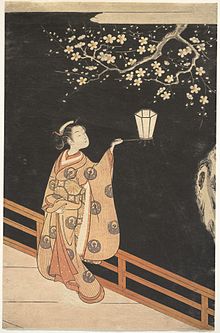
Colour print of a finely-dressed Japanese woman holding a lantern at night, admiring the plum blossoms.


On the Underground today, travelling East under London to the British Psychological Society offices, I recalled Ezra Pound’s 1913 poem:

Faces on the Metro, White petals on a black bough.

Mis-recalled, as it turns out, in that I conflated the title with the 14 word poem itself. Here are the actual words:

In a Station of the Metro

The apparition of these faces in the crowd;
Petals on a wet, black bough.

Including the title brings the original work to 20 words, which seems verbose for Imagist verse. My long-remembered, mangled and compressed version is only 10. Dropping the contrasting white on black image brings it down to 9, but loses the allusion to Chinese art, from which Pound drew inspiration. Perhaps “wet” needs to be retained, for explanatory reasons if nothing else.

This is a day for personal and happy reflection, so brevity is apposite.

Near Tabernacle Street I had a look at  John Wesley’s house on the City Road, just by the chapel where he is entombed.  The story, probably apocryphal, is that at an open air sermon he was giving on the Day of Judgment someone in the vast crowd called out: “If tomorrow was the day of judgment, what would you do?” He replied: “Sir, I would carry out my engagements”.

Wednesday, 28 October 2015

Can tests predict academic outcomes?

http://www.isironline.org/isir-2015-invited-address-paul-sackett-nathan-kuncel/

Paul Sackett and Nathan Kuncel cover a lot of ground in this talk, and slay a lot of dragons as well. Test bias, critical thinking, tests of rationality, the idea that once you have basic intelligence higher scores don’t contribute anything more: all those sorts of beasts.

A distinguished member of the audience commented to me at the time: Paul Sackett and Nathan Kuncel utterly destroyed the idea that SAT tests do not predict college performance. Their "ginormous" dataset comprised over a million students. A droll and data rich talk, they left myths about the non-utility of standardised tests lying like road-kill on the highway of evidence.

The link is above, but here are their conclusions:

Tests predict academic performance

The final point is somewhat obscured by their modesty: they have ginormous data sets (1.2 million students), which they analyse very carefully, looking at many confounding variables. Clever sillies who want to muddy the water can always find a small sample to prove anything they want. A more dependable picture emerges from the collation and evaluation of the available literature, graded for quality.

Here is a typical example of a clever silly being “lawyerly” rather than scholarly:

image

Psychology will never get anywhere if this sort of courtroom science is given any credence.

Colleges and schools are prone to the “rubber ruler” distortion: academic scores for easy subjects boost apparent ability, so corrections have to be made for the difficulty of courses. Academic performance measures often conflate exam results with attendance scores (and even credits for taking part in experiments). The purer the measure of academic ability, the more powerfully it can be predicted by good admission tests.

Sackett and Kuncel are good grinders and polishers, flicking away the dust to get to the polished steel. They know their data, and handle it with aplomb. By doing so they demolish lots of popular delusions.

Their talk is worth watching in its own right but also because they only take 45 minutes, which gives time for the audience to ask questions, and this gives you a look at some of the key researchers in the field, and an insight into their interests and opinions.

Monday, 26 October 2015

Bacon sandwich hysteria


The press are credulously reporting a World Health Organisation report: “Bacon, ham and sausages rank alongside cigarettes as a major cause of cancer, the World Health Organisation has said.”

They add: “Its report says each 50g of processed meat a day - the equivalent of one sausage, or less than two slices of bacon - increases the chance of developing bowel cancer by 18 per cent.”

An increase of 18% sounds very bad, almost as if your lifespan will be reduced by 18%

I know that sensible people would not touch a WHO report with a very long stick for fear of catching something, but this is very silly, even by their standards. They have ranked bacon sandwiches in that category not on their risk, but on the strength of the evidence that there is a very high probability of there being some risk, even if if it is very slight. That is, if WHO are certain that the risk is trivial, it goes into the top category of evidence based statements!

“Global health experts listed processed meat as a cancer-causing substance - the highest of five possible rankings, shared with alcohol, asbestos, arsenic and cigarettes.”

This is stupid, stupid, stupid.

It is part of a mendacious habit in which charities and health groups propagandise relative risks without mentioning absolute risks.

Here is the WHO press release, which gives the relative risk as 18% and without quantifying it further adds that the risk “remains small”. In which case, why the press release?

http://www.iarc.fr/en/media-centre/pr/2015/pdfs/pr240_E.pdf

Gerd Giggerenzer took all this nonsense apart in “Reckoning with Risk” 2002. Please read it again and again.

In fact, since the absolute risk of bowel cancer is low, that low absolute risk has simply become a little bit higher. (I have not looked at all the research: I am taking it on trust at the moment). To put it in context, Dr Ian Johnson, nutrition researcher and Emeritus Fellow, Institute of Food Research, said: " the (meat effect) mechanism is poorly understood, and the effect is much smaller than cigarette smoking on the risk of lung cancer. It is also worth noting that there is little or no evidence that vegetarians in the UK have a lower risk of bowel cancer than meat-eaters.” “Professor Robert Pickard, Emeritus Professor of Neurobiology at the University of Cardiff, highlighted a study of 60,000 Britons last year which found similar levels of bowel cancer in vegetarians and meat-eaters”.

The crude incidence rate in the UK is 65.8 per 100,000. The age-adjusted rate is 47 per 100,000 because cancer is largely an age-related condition. A very nasty thing to have, but as we age the probability of something having to be written on our death certificate increases.

Assume that everyone in the UK is vegetarian (the actual figures reflect the fact that the majority are omnivores already consuming red meat and processed meat) and the worst case scenario is that bacon will raise the age-related incidence rate from 47 to 55.5 per 100,000. Or, take things as they are, ban processed meat, and the age-related incidence rate falls from 47 to 40 per 100,000.

Science journalists: I think I was writing about them only a day ago.

Daylight robbery

As you all know, I don’t do policy, but every now and then I am tempted to urge legislators to use their intelligence. Yesterday was a case in point, when out of the blue friends spontaneously invited us to Sunday lunch, and we had to calculate what the time was. All our time pieces were scrupulously correct but some of them wrong, because officials had determined that official time had officially changed. This ritual is described as “putting the clocks forwards” or “back” as the case may be. Time itself is unperturbed, entropy continues, the sun is still shining whilst very slowly dying, but millions of citizens must adjust the time depicted on watches, kitchen clocks, microwaves, ovens, bedside alarms, video recorders, boilers, timed power plugs, cars and, as Borges might have said, Devices Which Keep Time that Have Been Forgotten.  

http://drjamesthompson.blogspot.co.uk/2013/10/clocks-back-time-forwards-traditional.html

The rational use of daylight was championed in the Special Report on Daylight Saving in 1908: To move the usual hours of work and leisure nearer to sunrise; To promote the greater use of daylight for recreative purposes of all kinds; To reduce the industrial, commercial and domestic expenditure on artificial light.

All that needs to be done is to find a time which maximises the use of daylight, and then stick to it, letting groups with special needs (schools, milkmen, burglars) set their own winter timetables.  For illustrative purposes, consider the origin of Time. Not the Big Bang, but the Observatory at Greenwich, for which the longitude is zero, and the Latitude 51° 28' 38'' N. At this place the shortest day (around 21 December) is 7 hours 45 minutes long and the longest day (around 21 June) is 16 hours 39 minutes.

Assuming that policy makers haven’t the time to read this blog because of pressing other engagements, here is a picture for them to glance at,  called Darkness at Noon, since it is suddenly unseasonably dark here in London. Given this startling turn of affairs, I am suddenly pressed for time as well. Can someone with better skills please

a) draw it better

b) solve the puzzle by choosing 6, 7 or 8 as the standard fixed starting time for Londoners, and draw it in?

IMG_2895

Sunday, 25 October 2015

Should scientists talk to journalists?


image


In the spirit of full disclosure, I came to the conclusion that scientists should talk to journalists in 1980. The British Psychological Society, after deep thought and protracted prevarication, decided to let The Press know what topics they would be discussing at their annual conference. Many members grimly predicted that this strategy would come to no good. Duly encouraged, journalists picked up a paper I was presenting, and such was the novelty of a member of the society being interviewed that the newly appointed society Press Officer came with me to to watch the whole process in a provincial BBC radio studio, where I was interviewed “down the line” by John Dunn. Of course I remember my first ever interview. It felt as if it went well: the interviewer had been well prepared, in the best Reithian tradition, and guided me through a general exposition of the results before hitting me with one of the surprising findings, thus giving the impression he had read the entire paper and noticed an anomaly. It was a friendly and chatty item, to a good sized afternoon radio audience.

The back story is that the Society had deliberately contacted the press, providing them with press releases on several highlighted talks they though would be of general interest. To fit in with our new wish to encourage the public understanding of science I had changed my original departmental seminar title from something like “Methodological issues arising from a replication of a short training program in medical interviewing techniques” to “Patient preferences and the bedside manner”.

After my triumph, I settled back to bask in media attention, but had to wait several years for the next interview, in which I was talking about drug taking among nuclear weapons guards. Coming out from the TV studio I was mildly surprised that the journalists in the newsroom, who must have seen my astounding broadcast on their monitors, were calmly going about their business. I thus learned an important lesson: it is hard to get on the media, but when you do, no-one notices. Since then I have probably done over 500 TV interviews, simply out of a personal egotistical wish to talk about psychology, on the basis that if I have read something interesting or done some research I want to talk about it to as big an audience as possible. For example, if you do a 3 minute TV interview watched by 1 million viewers, instead of more usual one hour lecture to 30 students, your impact rises from 30 an hour to 50,000 an hour. You may worry that TV viewers pay less attention, but 3 minutes is the more digestible attention span, so work hard to gain their attention. Should all researchers talk to the press? Probably not. You must want to talk, be willing to prepare yourself carefully, and accept that what you say must be adapted to the medium and the audience.

So, it was with an air of weary snootiness that I looked at the video of Alice Dreger’s talk at ISIR 2015 in Albuquerque. “Teach me something” was my attitude. I soon started taking notes.

First, Dreger explains that the relatively well prepared interviewer is now something of a historical anomaly. Science journalists in particular are unlikely to be given much time to read up on any issue, and may have to submit their story in about 3 hours. (They may not actually know much science, or worse, have some basic knowledge which they over-value). They are low in the pecking order, and unless the research has obvious implications, particularly for health, the item may be truncated, given a misleading headline or simply dropped. Getting media training is a good idea, or at the very least get an understanding of how journalists work. For academia, the message is: take your time, but you must get it right. For journalists the message is: now or never, but it must get noticed. However, if you don’t talk to journalists the most plausible charlatan will have a field day, and that is not just the charlatans in your own university. It is an open microphone event, and if you want to be heard you have to approach the microphone.

Your published paper is totally inadequate for science journalists. (Most science papers have a very small readership, perhaps even smaller than that for adolescent poetry). Get yourself out of the required academic zombie detachment into friendly engagement. Be kind to journalists, as you would be to a student who is anxious to learn, but very muddled. Get an understanding of what they want to find out, and try to give the best explanation you can. If you help them then they will come back and may help you. (I have sometimes formed a team with one journalist when I felt misrepresented by another, and taken advice on the best pincer counter-attack). Get your media department to give you advice, training, and some practice with possible questions. If you get misrepresented, correct the errors immediately (within minutes) or the errors will reverberate across the internet endlessly. Get support and advice about how you keep up your defences (some universities have a media minder who does much of the job for you).

In the new media age readers expect the news to be free (rather like blogs). Science journalism is not a money spinner, more of a loss leader. Because of the internet, news travels further and faster. Crap gets First Mover Advantage. Corrections become mere toilet paper. Try to get the correct story out first. In ancient times journalists sent you a draft of what they were going to publish, so you could suggest corrections. In present times the best you can hope for is to ask them, towards the end of the interview, if they would please read out the main points they have written down (I never do this, but reckon it is worth a try). Journalists are rewarded by attention. Sneer if you wish, but I doubt that a headline has never caught your eye. Freddie Starr ate my hamster. https://en.wikipedia.org/wiki/File:Freddiehamster.jpg

At the conclusion of her talk, Dreger goes off in an interesting direction. She points out that (though scientist was not coined till 1833) the American Founding Fathers were interested in science, as was so often the case in the Enlightenment, that age of wonder. Their championing of democracy and their attack on aristocracy was entirely consistent with their curiosity about the natural world and the consequent notion that discovery should be subject to peer review: governments were tested by collecting citizen opinion, findings were tested by getting peer opinion. Talking to the press is part of holding yourself accountable. If you don’t already do it, practice and participate.

http://www.isironline.org/isir-2015-holden-award-address-alice-dreger/

By the way, the ISIR Albuquerque videos are very well made. Instead of the usual out of focus, distant projector screen, with a speaker floating about like a droning, fuzzy blob, they have integrated separately filmed close ups of speaker and screen, so as they switch from one to the other you can almost participate in the talk. But not ask questions. Do that, if you wish, in your comments.

Friday, 23 October 2015

Thoughtwebs to wordstrings


Pinker on language is a treat: he gets the point, and to the point, conveys it quickly.

Language is an app for converting a web of thoughts into a string of words.

Speaking is easy, writing is hard. Classic writing was based on language being a window into a world. Last night I dreamt I went to Manderley again. It seemed to me I stood by the iron gate leading to the drive, and for a while I could not enter, for the way was barred to me. There was a padlock and a chain upon the gate.

Sequence matters: the reader needs to know what happened next, and who did what to whom. Active voice is fine, passive voice just as fine when you need to maintain the reader’s focus on a chain of events.

Word strings contain ambiguities, so they need to be worked on until the meaning is clear. Writing involves solving problems of dependent implications: words and phrases in the wrong places create eddies of confusion. (Write in the morning, edit in the evening). Text is a matrix, clarity a work of art.

(Here is a clumsier second version, put in at the editing stage and then taken out again:  Text is a matrix to be arranged with care, pruning out unintended consequences: clarity a work of art.)

The curse of knowledge is imagining that because you know something, everyone else does, and explanations are not necessary. Overcoming that curse requires getting a few target readers to go through your draft to let you know what they don’t understand.

Then: (my paraphrase)Write to make sense.

1) Get your ideas down on the page

2) Arrange the words so the ideas rise off the page for the reader.

The better the writer, the more he will be believed. Many critics of intelligence testing write very well, and carry their readers with them, as good writing usually does. Intelligence researchers must write better. Don’t apologize: explain. Don’t hedge: bet.

These are brief reflections after watching Steven Pinker’s invited presidential address at the ISIR conference in Albuquerque.

http://www.isironline.org/isir-2015-presidents-invited-address-steven-pinker/

I hope I will find it easier to write well.

Thursday, 22 October 2015

Here’s to your health, all 13 parts of it


In general how would you rate your overall health?

Excellent/Good/Fair/Poor/Do not know/Prefer not to answer ?

Self rated health is not a measure I would rate very highly, since it would seem to enfold both the ill and the hypochondriacal in a wetly amorous embrace, leading to nosological confusion. Surely it must be better to take your pulse, blood pressure, and do a full diagnostic workup rather than give any credence to fallible self-observation?

On the contrary, this very general question has extraordinary power. Better Self Rated Health showed positive genetic correlations with intelligence (rg = 0.40), education (rg = 0.59), longevity (rg = 0.33), anorexia nervosa (rg = 0.11), and forced expiratory volume in one second (FEV1) (rg = 0.29). Negative genetic correlations were found between better SRH and neuroticism (rg = -0.38), BMI (rg = -0.41), ADHD (rg = -0.38), major depressive disorder (rg = -0.46), schizophrenia (rg = -0.17), systolic and diastolic blood pressure (rg -0.14 and -0.16), coronary artery disease (rg = -0.33), ischaemic stroke (rg = -0.21), and type 2 diabetes (rg= - 0.38). No associations were found for Alzheimer’s disease, bipolar disorder or the ischaemic stroke subtypes.

How do we know this?

Molecular genetic contributions to self-rated health. bioRxiv preprint first posted online October 20, 2015; doi: http://dx.doi.org/10.1101/029504;

Sarah E Harris, Saskia P Hagenaars, Gail Davies, W David Hill, David CM Liewald, Stuart J Ritchie, Riccardo E Marioni, METASTROKE consortium, International Consortium for Blood Pressure, CHARGE consortium Aging and Longevity Group, CHARGE consortium Cognitive Group, Cathie LM Sudlow, Joanna M Wardlaw, Andrew M McIntosh, Catharine R Gale, Ian J Deary.

http://biorxiv.org/content/biorxiv/early/2015/10/20/029504.full.pdf

The Edinburgh gang and their far-flung confederates have crunched the data from UK Biobank in which roughly 500 000 individuals aged between 37 and 73 years were recruited in the United Kingdom between 2006 and 2010. They underwent testing of cognitive abilities, physical and mental health examinations, completed questionnaires about lifestyle, socio-demographic background and family medical history, and agreed to have their health followed longitudinally. For the present study, genome-wide genotyping data were available for 112 151 individuals (58 914 females, 53 237 males) aged 40 to 73 years (mean = 56.91 years, SD = 7.93).

Neuroticism was measured with  12 questions of the Eysenck Personality Questionnaire-Revised Short Form (EPQ-R Short Form). Intelligence was measured by a thirteen item-test with a time limit of two minutes, completed by 36 035 individuals. Six items were verbal and seven numerical. An example of a verbal question is ‘Bud is to flower as child is to?’ Possible answers: 

‘Grow/Develop/Improve/Adult/Old/Do not know/Prefer not to answer

An example of a numerical question is ‘If sixty is more than half of seventy-five, multiply twenty-three by three. If not subtract 15 from eighty-five. Is the answer:

Possible answers: ‘68/69/70/71/72/Do not know/Prefer not to answer

The Intelligence score was the total score out of thirteen. The Cronbach α coefficient for the thirteen items was 0.62 which is reasonable, given that the whole thing takes no more than 120 seconds. And yes, it uses paper and pencil.

Then they crunch all the slushy stuff that is the very code of life, in various ways, but I will stick to the summary of the genome wide analysis. The GWAS identified 13 independent signals associated with SRH, including several in regions previously associated with diseases or disease-related traits. The proportion of variance in SRH that was explained by all common genetic variants was 13%. Polygenic scores for the following traits and disorders were associated with SRH: cognitive ability, education, neuroticism, BMI, longevity, ADHD, major depressive disorder, schizophrenia, lung function, blood pressure, coronary artery disease, large vessel disease stroke, and type 2 diabetes.  In summary: Genetic variants associated with common diseases and psychological traits are associated with self-rated health. The SNP-based heritability of self-rated health is 0.13 (SE 0.006). There is pleiotropy between self-rated health and psychiatric and physical diseases and psychological traits.

image

Here is the cracker finding: This study shows that the SRH measure, consisting of only one question, is able to reflect the genetic variants of traits and disorders, such as intelligence, personality, cardio-metabolic disease and psychiatric disorders, associated with actual health. Genetic variants associated with higher levels of intelligence and lower levels of cardio metabolic diseases are associated with better health ratings. This supports the theoretical construct of bodily system integrity, a latent trait indicating individual differences in encountering health and cognitive challenges from the environment. Individuals with better system integrity are likely to have higher levels of intelligence, fewer diseases, a better overall health and greater longevity.

The paper is worth reading in detail to get the full argument, and discussions on particular matters like the positive link with anorexia nervosa. System integrity, which Deary named as an afterthought, turns out to be a very powerful concept, increasingly well supported by genetic research. A strength of this study is the large sample size of UK Biobank, permitting powerful and robust tests of pleiotropy between SRH and many health related traits. Other strengths include that all individuals were of white British ancestry, minimising population stratification.

[Note to new readers: Current de facto practice is to avoid genetic group comparisons, despite it being a potential source of understanding genetic effects. However, since genetic groups differ, putting them all into a study can confuse the result. This is one case where apartheid is encouraged, and whites are studied separately.]

The authors end by saying: Measuring people’s overall health is difficult, because the state of the body and mind can be disrupted in many ways, and people’s perceptions of the same objective bodily state can differ. Notwithstanding this complexity, the responses to a single subjective question about whether a person is in good or poor health has proved valid and useful in health research. The present study has been able to identify many genetic contributions to SRH, confirming the complexity of the contributions to the phenotype, and also its partial foundations in genetic differences. The single subjective item of SRH picks up the contributions from many background systems, including mental and physical health, as well as cognitive abilities and personality.

One little question, one very big result.

Wednesday, 21 October 2015

Robert Plomin: “We are truth seekers”

http://www.bbc.co.uk/programmes/b06j1qts


image


The above link takes you to the series of The Life Scientific, in which Jim Al-Khalili interviews scientists, this time Robert Plomin. The program approach centres on the research work of the interviewees, with some examination of the personal factors which led to their main scientific interests. Al-Khalili has a easy style, with the scientists getting a good chance to explain themselves.

To me the great charm of this interview is hearing how a boy from a poor Chicago family was identified and nurtured by teachers at a school which used intelligence tests to identify student’s abilities, and how his family maintained their love and support of someone who otherwise might have found himself estranged by his different interests and his very different abilities. After all the horror stories about intelligence testing, this personal story shows the features which made testing so popular years ago, particularly on the political Left, because it identified bright working class children, whose parents could not afford private schools and personal tutors. Later, when intelligence tests were used as the gateway to heavily rationed, high quality secondary education in Britain they became the whipping boy for every rejected child, and in the end the best, most fair and most accurate indicator (though of course, not a perfect one) was dropped in favour of less good, less fair and less accurate methods, which were vague enough to draw far less political heat. IQ tests carried the rap for the profound resentment created by demand for a limited educational resource. Plomin says (9 min 44 secs) that IQ tests got him to university, but that since then: “Intelligence tests have since been forbidden in America (in schools), a real case of blaming the messenger”.

Al-Khalili gets into a couple of familiar grooves, as many interviewers on the topic do, and as their editors probably feel they must. The first is having a go at “the infamous Bell Curve” (10:17), without distinguishing between the data reporting of part 1 and the policy suggestions of part 2. Plomin explains why the second part does not invalidate the first, because “policy depends on values, not just knowledge” and people can attach different values to a set of observed facts (I am summarising here).

Plomin also says, regarding race differences in intelligence (10:39) “I have ducked them all my life, because it doesn’t explain much variance”. I am not a behavioural geneticist, but I would assume that looking at the genetics of two groups who differ in intelligence, even by only 15 IQ points on average, might give you an inkling whether there were any differences in the two genetic profiles which possibly related to intelligence. In the normal run of science, a difference is interesting because it may lead you to a cause. I think that the more usual reason for ducking researching race differences in intelligence is that it brings you and your team too much hassle, and research effort is wasted, and you will gain more understanding in related fields of genetic enquiry. Academia can be poisonous, so why put good scientists at risk of martyrdom when they can build better understanding of closely related matters?

Then Al-Khalili:  “My concern is that the very fact of describing children as having genetic weaknesses would have a detrimental effect on how they are seen and in time on how they see themselves”. “There are ethical issues about how that data could be used”.  “You can understand why people have avoided this subject for so long”.

Plomin puts up a very good defence. He point out that genetic research confirms: “It is a lot harder for some children to learn than others”. Pushed further, he comes up with a great remark: “We are truth seekers”

Plomin is an experienced interviewee, and does not need my help, but next time a journalist puts you through the usual trope that “your results raise ethical issues and may be twisted” (implying you should stop investigating) , just reply “suppression of enquiry raises even bigger ethical issues, and ignorance is a greater threat than knowledge”.

All things considered, “We are truth seekers” is the best answer.